The following are from interviews with reals students about choosing a college:
Lisa:
Take your time and research the college you’re going to, make sure you know what it’s about, take the time to visit the school, spend the night there if you can, spend a weekend there if you can, if you know people that go there already, ask their opinions on it.
Maria:
I was looking at their disability support services centers. Every time I went to visit I would go to the disability support services center to see how comfortable I felt with the staff, how helpful they seemed to be on that day, if they were willing to talk to me or not. I would definitely take a tour of … I took a tour of every campus that I applied to, just to see if I felt comfortable there. I also looked at what majors they offered, what my interests need, what the requirements were because I knew if there were a school that required that for some reason, I wouldn’t know why, I needed four years of a foreign language, that was a turn off to me due to my disability. So things like that, something … just a good feeling on the campus as well as the technical requirements to actually get the degree.
Manisha:
I also looked at the criteria of how the schools are ranked to help me pick which school I liked best for me. I did music so it was important to have a good music program, as well as strong programs in other aspects of the school because you never know when you have to take classes outside of your department and that’s important to know that you’re still getting a really good education outside of your department.
Andrea:
Cast a wide net, list all the schools you think you might want to go to and start there. And then … then you can start narrowing it down by reading more about it, contacting people at the university disability support services. I think it also can be really helpful to talk to other students at the university, even if you call disability support services and ask, do you have any student that’s affiliated with your office who might be willing to talk to someone who is considering the college, to give me a sense of what their experience has been like?
Manisha:
I also picked a school which happened to be located where my doctors are located, so for me that also helped instead of picking a different school because if I needed anything my doctors are right there, a couple of miles down.
Amy:
I knew going in that I wanted a school with smaller classes, when you got into your core classes, because I really enjoy learning but I’m a very interactive learner. So I wanted to be able to interact with the professors and ask the professors questions … and it was setting, I never thought I would end up at an urban school. I always thought I was gonna end up at a rural school with tons of trees and country and horses and dogs, because my family has a farm and I’ve just grown up with all the trees around me and everything. But when it came down to it, especially going in with an international focus, it came down to who has the most diverse student population.
Showing posts with label First generation. Show all posts
Showing posts with label First generation. Show all posts
Monday, November 29, 2010


Wednesday, June 9, 2010
First Generation First Year of College
Because first generation college students don't have immediate family members to give them inside tips on what to expect at college, they may find it harder to adapt to campus life. Here's what you should do as a first generation college student in order to have a successful first year in college.
 Attend freshmen orientation. Most colleges have freshmen orientations during the summer before the new school year begins. There are many benefits of attending freshmen orientation, such as learning your way around school before you have to start attending classes, making new friends, and learning how to register for classes.
Look for campus programs that assist first generation students. These programs will provide tutoring and counseling services to help you adapt to your first year.
Make friends with upperclassmen. Having a mentor in college to show you the ropes can be a big help. Finding an upperclassmen who is also a first generation college student is an added bonus because he can give you secrets on how he dealt with his first year.
Ask for the support of your family. Because your parents have never been to college, they may not understand some of the pressures involved. Give your family an idea of what college is like by talking to them about your daily activities. Balancing a college schedule can be extra hard for a first generation college student, so you will need all the encouragement you can get from your family.
Review all of the entries about campus life on this blog. Planning for college and adapting to campus life can be hard for first generation college students but still very achievable. If you want more tips for first generation students or have any questions, please contact your high school counselor or the Student Services department at your college.
 Attend freshmen orientation. Most colleges have freshmen orientations during the summer before the new school year begins. There are many benefits of attending freshmen orientation, such as learning your way around school before you have to start attending classes, making new friends, and learning how to register for classes.
Look for campus programs that assist first generation students. These programs will provide tutoring and counseling services to help you adapt to your first year.
Make friends with upperclassmen. Having a mentor in college to show you the ropes can be a big help. Finding an upperclassmen who is also a first generation college student is an added bonus because he can give you secrets on how he dealt with his first year.
Ask for the support of your family. Because your parents have never been to college, they may not understand some of the pressures involved. Give your family an idea of what college is like by talking to them about your daily activities. Balancing a college schedule can be extra hard for a first generation college student, so you will need all the encouragement you can get from your family.
Review all of the entries about campus life on this blog. Planning for college and adapting to campus life can be hard for first generation college students but still very achievable. If you want more tips for first generation students or have any questions, please contact your high school counselor or the Student Services department at your college.
Tuesday, June 8, 2010
Tips for First Generation College Students
 Being the first person in your immediate family to attend a postsecondary institution may seem daunting. Without help from family members, you may not even know where to begin the college planning process, much less know what to expect once you get to college. The following info should give you a better understanding of the postsecondary route and help ease your anxiety of being a first generation college student.
College Planning
Planning for college is often more difficult for first generation college students because they probably don't have assistance from a knowledgeable family member. If you need help with the college planning process, here are some tips:
Get acquainted with your high school counselor. As someone who wants to be a first generation college student, you will need a lot of help from your school counselor. Throughout your four years of high school, your counselor will be there to answer any questions about the different aspects of college planning, so be sure to utilize him or her as a valuable source.
Look for outreach programs that can provide mentoring services to help you prepare for college. Your high school may even offer this service as an after-school program.
Get your parents involved in the college planning process. Since planning for college will be a new experience for them as well, you should try to keep them informed about what needs to be done. Encourage them to meet with your high school counselor too. Often, a parent's biggest concern is how to pay for college, so try to get your parents to attend a financial aid workshop in your area. Keep in mind that if you are a dependent student, your parents will have to sign the FAFSA (Free application for Federal Student Aid) in order for it to be processed. The FAFSA is the form you and your parents must fill out in order for you to be eligible for state and federal financial aid. It is very important to fill this form out as soon as possible after January 1st of your senior year of high school. And remember: you must reapply for financial aid as soon as possible after January 1st each year that you are in college by filling out a renewal FAFSA.
Stay on track. Make sure to do each of the following so you stay on the postsecondary path:
• Register for appropriate classes. Meet with your school counselor during your freshman year of high school (preferably earlier) to discuss what classes you should be taking for all four years.
• Keep your grades up.
• Get involved in extracurricular activities.
• Research colleges and careers.
• Take the PSAT.
• Take the SAT and/or the ACT.
• Attend college fairs.
• Visit college campuses.
• Attend a financial aid workshop.
• Research/apply for scholarships.
• Submit your college admissions applications. Watch out for deadlines.
• Submit the Free Application for Federal Student Aid (FAFSA) as soon as possible after January 1st of the year for which you are requesting aid.
• Review your financial aid award letter and accept the awards you would like to receive.
Monday, March 22, 2010
Multidimensional Poverty – Reevaluating Past Assumptions…
In a recent article in the Chronicle of Higher Education the question was asked: What makes someone poor? Among those who study poverty, the answer has long been a lack of money. If your income falls below a certain level, you're poor. The basic assumption is the same: It's what’s in your wallet that matters.
But maybe there's more to it. Maybe poverty is about not having enough food, access to health care, reliable transportation, adequate sanitation, food, shelter, and a dozen other things that make life bearable. This multidimensional approach has been getting a lot of attention lately. It makes you wonder if the way we've been measuring poverty for decades has been, if not wrong, then maybe incomplete.
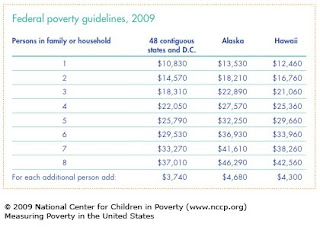 Theoretically, it is easy to see that poverty could be about more than income, but actually trying to measure those other factors… Well, it can’t be easy. Calculating income-based poverty is pretty straightforward, if you make X amount and have Y people in your family you are either poor or not (see chart above)… but trying to quantify a wide range of data about well-being is considerably more complicated and laden with potential difficulties in measuring variables that have long been overlooked.
A multidimensional method will allow us (researchers, economists, and officials) to decide which categories to include in the poverty calculation, how many categories must be deficient to make a person poor, and to also weight certain categories as more important than others. For instance we could decide that food matters more than transportation.
So why redefine what it means to be poor anyway? Isn’t income data enough? Well, no.
 For starters you get a more complete and accurate picture of who needs help and what kind of help they need. The Bing Foundation only effects poverty indirectly… we help people go to college and get educated. However, statistics show that those with a college degree (even if it is only an Associate) earn more than those with just a high school diploma. Providing education does not necessarily raise anyone's income, but it should create opportunities to substantially improve quality of life. Traditionally, need-based financial aid is all about income levels… We use income, the family’s previous education, family size, grades, and a myriad of other weighted categories to determine who gets a scholarship.
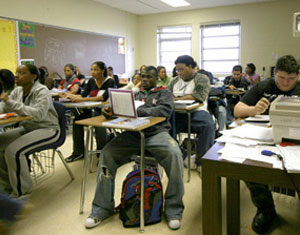 We focus on schools and districts laden with traditionally underserved student populations (first generation students, minorities, financially needy, etc) for our college preparation and counseling efforts.
Having a way to measure improvement in areas other than income allows a government or an organization to demonstrate how it is helping its citizens, or a critic to show how it's failing to help them. Hopefully we will see success in this new multidimensional approach to poverty and that will translate into more help to get people educated and more lives changed.
But maybe there's more to it. Maybe poverty is about not having enough food, access to health care, reliable transportation, adequate sanitation, food, shelter, and a dozen other things that make life bearable. This multidimensional approach has been getting a lot of attention lately. It makes you wonder if the way we've been measuring poverty for decades has been, if not wrong, then maybe incomplete.
Theoretically, it is easy to see that poverty could be about more than income, but actually trying to measure those other factors… Well, it can’t be easy. Calculating income-based poverty is pretty straightforward, if you make X amount and have Y people in your family you are either poor or not (see chart above)… but trying to quantify a wide range of data about well-being is considerably more complicated and laden with potential difficulties in measuring variables that have long been overlooked.A multidimensional method will allow us (researchers, economists, and officials) to decide which categories to include in the poverty calculation, how many categories must be deficient to make a person poor, and to also weight certain categories as more important than others. For instance we could decide that food matters more than transportation.
So why redefine what it means to be poor anyway? Isn’t income data enough? Well, no.
For starters you get a more complete and accurate picture of who needs help and what kind of help they need. The Bing Foundation only effects poverty indirectly… we help people go to college and get educated. However, statistics show that those with a college degree (even if it is only an Associate) earn more than those with just a high school diploma. Providing education does not necessarily raise anyone's income, but it should create opportunities to substantially improve quality of life. Traditionally, need-based financial aid is all about income levels… We use income, the family’s previous education, family size, grades, and a myriad of other weighted categories to determine who gets a scholarship. We focus on schools and districts laden with traditionally underserved student populations (first generation students, minorities, financially needy, etc) for our college preparation and counseling efforts.
Having a way to measure improvement in areas other than income allows a government or an organization to demonstrate how it is helping its citizens, or a critic to show how it's failing to help them. Hopefully we will see success in this new multidimensional approach to poverty and that will translate into more help to get people educated and more lives changed.
Subscribe to:
Posts (Atom)